Public program

Courses

Published courses without auth. Structure, level, and subscription requirements are visible.

Git as Engineering Discipline
Beginner Plus

Git as Engineering Discipline

A practical Git course for developers who want more than memorized commands: understand the model, keep a clean history, work safely with branches, resolve conflicts, and ship changes without chaos.

Open course
Docker Engineering Environment
Beginner Plus

Docker Engineering Environment

A practical course on Docker development environments: Docker Engine 29.x, Docker Compose v2, Dockerfile, the image/container model, volumes, networks, healthchecks, Traefik v3.6, PhpStorm, Xdebug, and an engineering Make workflow. The course teaches reproducible local environments as a team contract, not blind container startup.

Open course
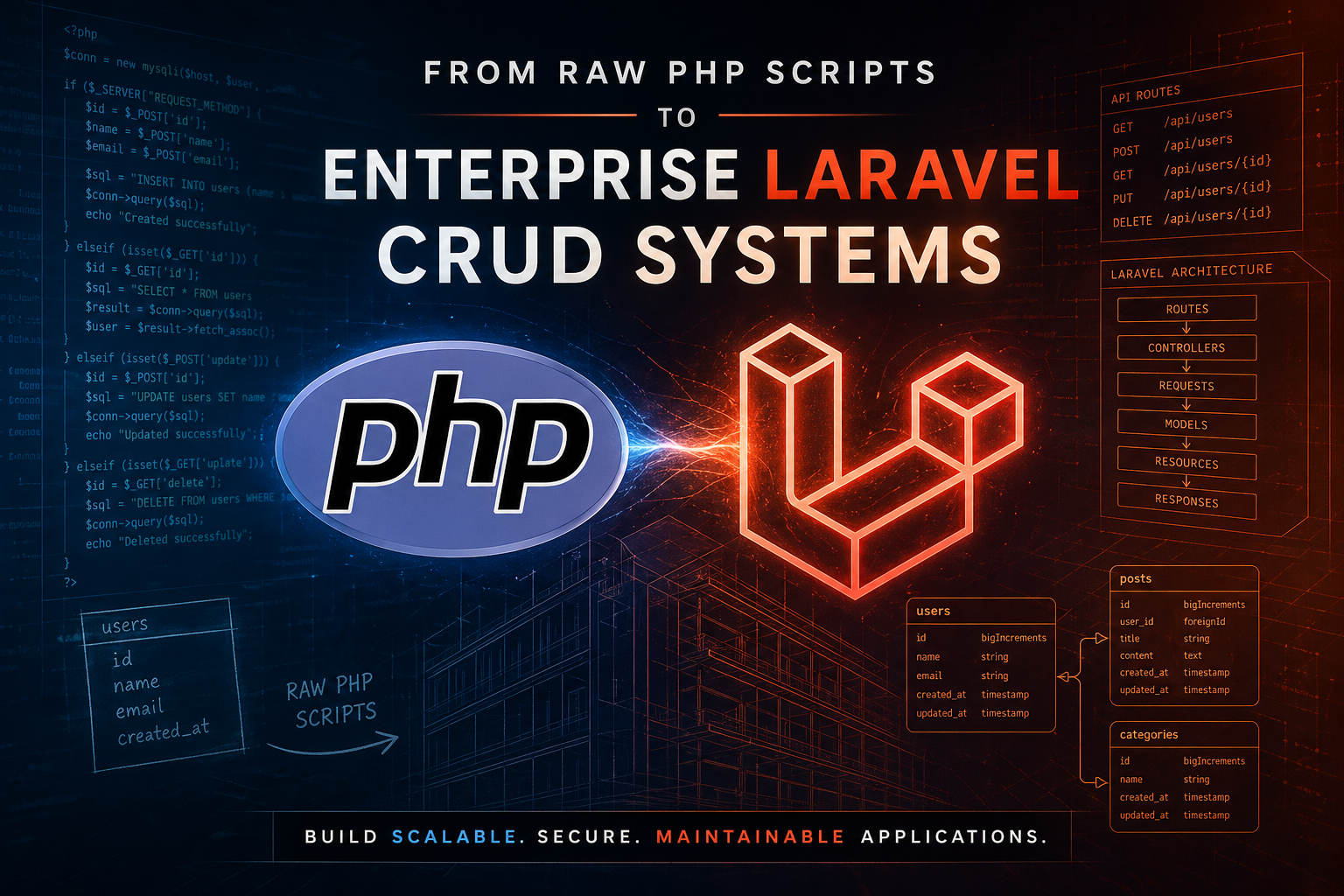
From PHP Syntax to Enterprise CRUD
Beginner Plus

From PHP Syntax to Enterprise CRUD

A practical beginner course: from HTTP, PHP runtime, files, and JSON to OOP, Composer, SQL/PDO, tests, Laravel 13, Eloquent, authorization, queues, and Filament admin UI. The cross-cutting project is an NSI management system with products, categories, units, suppliers, users, and roles. The course targets PHP 8.3-8.5, Laravel 13, and Filament 5.

Open course
Developer Business Thinking: DDD-lite and Laravel
Intermediate Plus

Developer Business Thinking: DDD-lite and Laravel

A practical course on evolving an existing Laravel/Filament CRUD into a business-aware system: domain language, processes, rules, flexible product attributes, DDD-lite, use cases, application services, Laravel adapters, and tests of meaning.

Open course
Laravel in Production: Octane, FrankenPHP, and the Long-Running Lifecycle
Advanced Plus

Laravel in Production: Octane, FrankenPHP, and the Long-Running Lifecycle

This course explains what changes when a Laravel project moves from the familiar nginx + PHP-FPM model to a long-running runtime with Laravel Octane and FrankenPHP. You will examine repeated bootstrap, warm workers, retained state, persistent connections, race conditions, memory leaks, watch/reload workflow, honest benchmarks, and production restart strategy.

Open course
Quality Pipeline and First Observability for a Laravel Project
Advanced Plus

Quality Pipeline and First Observability for a Laravel Project

After Git, Docker, PHP, Laravel, DDD-lite, and Octane, the student already knows how to write working code and understand the application lifecycle. But working code is not the same as change readiness, review readiness, or deployment readiness. If quality depends on whether the developer remembered to run tests, rebuild the frontend, or catch an issue during review, the project remains fragile. This course treats quality as an engineering pipeline. The student takes an existing Laravel/Filament/Octane project and gradually builds a feedback system around it: local Make commands, automatic formatting, static analysis, controlled Rector usage, testing strategy, coverage reports, parallel tests, GitHub Actions, pre-commit hooks, structured logs, healthchecks, and simple architecture guards. The main result is a shift in thinking. Works on my machine is no longer a readiness criterion. Readiness means the project can be checked with one clear command, the same checks can run in CI, important runtime signals are visible, and the remaining manual risks can be named honestly.

Open course
Metrics and Observability: Prometheus + Grafana for Backend Engineers
Advanced Plus

Metrics and Observability: Prometheus + Grafana for Backend Engineers

After the quality pipeline course, the student can verify a project before merge: make qa, tests, static analysis, build, healthchecks, and architecture guards. But a green pipeline does not answer how the system behaves under real load. An endpoint can pass tests and still be slow. A queue can build backlog. An Octane worker can slowly grow memory usage. Users can suffer from p95 latency while the average still looks harmless. This course moves the student from intuition to data. Using the existing Laravel/Filament project, the student adds Prometheus and Grafana, exposes /metrics, instruments HTTP routes, queues, and runtime signals, builds a dashboard, defines SLI/SLO, and learns to connect graphs to action. Metrics are not decoration here. Every signal must answer an operational question: how fast, how many errors, what is happening to the queue, what is happening to the worker, and when someone needs to react. The main outcome is a new engineering habit. An architecture decision can no longer be defended with "it feels faster". The student needs a baseline, a metric, a graph, a causal explanation, a tradeoff, and the remaining risk.

Open course
Clean Architecture in a Corporate Laravel Environment
Advanced Plus

Clean Architecture in a Corporate Laravel Environment

This course continues the learning Laravel/Filament reference data system and moves it into Clean Architecture without religious overengineering. You will study why business rules should not live in a controller, Filament resource, Eloquent model, or console command, and you will learn how to design scenarios around actors: creating nomenclature through the admin panel, through API, and through document import. The main idea of the course is loose coupling from concrete implementations. Laravel, Filament, Eloquent, a queue, a database, and the import format are important, but they should remain external details. Inside there should be use cases, commands, queries, handlers, domain rules, contracts, and adapters. That is why the course separately covers CQRS, the Dependency Rule, actor-specific use cases, ports/adapters, mappers, transaction boundaries, layer testing, and deptrac/deptrac as an automatic architecture guard. The course uses a practical car body analogy: the front and rear parts of a car crumple on impact to protect the cabin and the people inside. In an application, Presentation and Infrastructure play a similar role: they absorb the impact of change so that Application and Domain remain stable. By the end of the course, you will have a clear Clean Architecture structure in src, several actor-specific nomenclature scenarios, command/query side separation, infrastructure adapters, presentation adapters for HTTP, Filament and Console, a Deptrac ruleset, and a final architecture defense of the solution.

Open course